Planning a Lipstick Shade Range Without Too Many SKUs
A lipstick launch does not need a large shade wall to look complete. Start with a core range that covers distinct user needs, make each shade visibly different in undertone or depth, and use sales evidence before expanding into shades that divide the same audience.
Key takeaways
- Define the customer and occasions before naming a shade count.
- Choose shades for distinct roles rather than small cosmetic differences.
- Calculate order quantity and cash separately for every SKU.
- Use sell-through and return reasons to decide later extensions.
How many shades belong in the first launch?
There is no universal correct count. The useful number is the smallest range that represents distinct customer choices and launch channels. A brand serving one narrow audience may need fewer shades than one entering a broad retailer, but every shade creates its own forecast and stock risk.
List the jobs each shade performs: everyday neutral, deeper neutral, warm statement or seasonal accent. If two shades have the same job and differ only slightly, ask whether the distinction is obvious on the intended user and in the retail environment.
How can the range avoid overlapping itself?
Map undertone, depth and occasion on a simple grid. Leave space between shades unless the brand has evidence that a small step is meaningful to its customer. Distinct names do not create distinct demand when customers see two bullets as nearly identical.
Use physical masters under consistent lighting and on the intended wearer group. Camera swatches can exaggerate or conceal undertone. Keep each approved shade card, formula version and component decoration tied together.
What does a partner need to understand?
The partner should receive the launch audience, shade roles, component plan, target quantity by SKU and approval calendar. Yunmei describes a lipstick process from formulation determination to sample preparation and supports fine-tuning fragrance, texture, skin feel and efficacy.
Do not send a mood board as the only specification. Translate it into observable shade direction, payoff, texture, pack and reference images with controlled lighting. The more specific the brief, the more useful the first sample round becomes.
The lipstick product page outlines the development process relevant to private label lipstick manufacturers; use the published details to anchor the buyer brief, not as a substitute for product-specific testing.
How does MOQ multiply across shades?
A per-product minimum applies to each shade or formula as stated in the quotation. If a launch has six shades at 1,000 units each, the brand is planning 6,000 units, not one 1,000-unit lipstick order. Add packaging and component minimums separately.
Yunmei publishes a usual 1,000–5,000-unit MOQ per product and an entry point as low as 500 units for start-up brands. Confirm how the supplier defines a product when several shades share a base or component.
| Shade role | Share of six-shade units | Units |
|---|---|---|
| Core neutral (2 shades) | 50 | 3,000 |
| Distinctive daily (2 shades) | 33.3 | 2,000 |
| Statement/test (2 shades) | 16.7 | 1,000 |
Which shades should receive the largest first quantities?
Allocate more units to shades supported by audience research, existing sales or a clearly defined hero role. Keep experimental shades smaller when the supplier's commercial terms allow it, and avoid dividing stock evenly just because the shade names appear as equals on a launch slide.
Record the forecast assumptions by SKU. If the neutral shade is expected to sell twice as fast as the accent, the purchase plan should reflect that rather than using one quantity for every colour.
What should the sample process validate?
Test shade, payoff, glide, texture, fragrance and packaging with the intended user group. A successful colour alone does not establish that the bullet survives daily use or that the mechanism protects the product.
Use one controlled master per shade and a separate review sheet. Yunmei's stated fine-tuning areas include fragrance, texture, skin feel and efficacy; keep each comment attached to a specific sample code so the revisions do not cross shades.
When is it time to add a new shade?
Wait for evidence from sell-through, repeat purchase, returns and customer requests. A new shade should fill a visible gap or serve a proven segment, not merely expand the catalogue. Check whether the existing range already meets that need with better merchandising.
Review stock age and component leftovers before ordering. A new colour may require fresh pigment or decoration even when the package is shared, so the extension needs its own cost and schedule review.
Worked example: SKU count and inventory commitment
At 1,000 units per shade, a three-shade launch requires 3 × 1,000 = 3,000 units. At an illustrative $3.80 landed cost each, inventory value is $11,400. A six-shade launch at the same assumptions needs 6,000 units and $22,800. Replace the illustrative cost with a supplier quotation before approving the range.
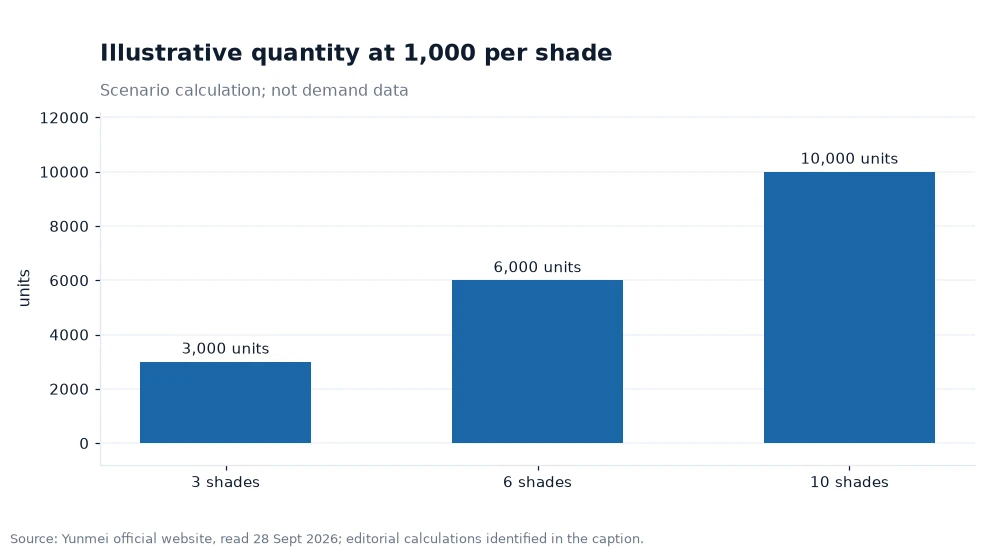
The order band is broad, so the brand should model multiple quantities. Choosing a shade count without estimating units per shade hides the actual cash commitment.
Frequently asked questions
Should a first lipstick collection launch with equal quantities of every shade?
Not automatically. Allocate by audience evidence and shade role, while confirming each product minimum and component commitment with the supplier.
Can several shades share one formula?
Some development elements may be shared, but pigment, performance and approval still need shade-specific review. Confirm the supplier's definition of MOQ by product and colour.
What data should trigger a shade extension?
Look at sell-through, repeat purchase, returns, customer requests and gaps in the existing undertone-depth map. A new shade should solve a documented need.
Make range breadth earn its inventory
A compact, differentiated set is easier to explain, test and replenish. Let customer evidence decide when the next shade adds genuine choice rather than another slow-moving SKU. Range planning should include how shades appear together on a product page and in physical merchandising. A compact assortment needs clear descriptions, consistent swatches and a sensible way for customers to find a match. Ask a small group to sort shades by undertone and occasion without seeing the internal names; confusion can reveal overlap. Review returns and customer questions after launch, not only sales totals. A shade that sells slowly may still fill an important need, while a popular colour may have been bought once as a gift. Combine quantitative movement with customer feedback before deciding whether to discontinue, replenish or extend the family. Before the project is closed, compare the approved record with the exact item being purchased. Check the version, quantity, component and evidence reference rather than relying on a remembered conversation. Ask the supplier to confirm any open assumption in writing, and save that confirmation with the quotation. If an answer changes the brief, update the sample and calendar before releasing the next commitment. This final reconciliation gives the brand a clear basis for later questions from production, quality or customer service. It also makes the next order easier to plan because the team can distinguish what was learned from what was merely assumed during the first launch. Once the assortment is approved, make the range legible to both customers and the fulfilment team. Use consistent shade imagery, names and codes, and check that labels remain distinguishable when cartons are stacked together. A picking error between two similar shades can become a return even when each formula is correct. Review barcode and inventory setup before the first shipment, then sample-check orders during launch. If the product is sold online, explain undertone and depth in plain language and avoid relying on a monitor-perfect colour match. Collect questions that reveal confusion and update descriptions carefully. Better navigation can improve the experience of the existing range before the brand commits cash to additional colours. Review Yunmei’s OEM/ODM manufacturing overview and use the same written brief for every sample round.
Yunmei's lipstick, order and timeline guidance was consulted on 28 Sept 2026. Shade allocations and landed-cost arithmetic are scenarios, not demand forecasts.[1].