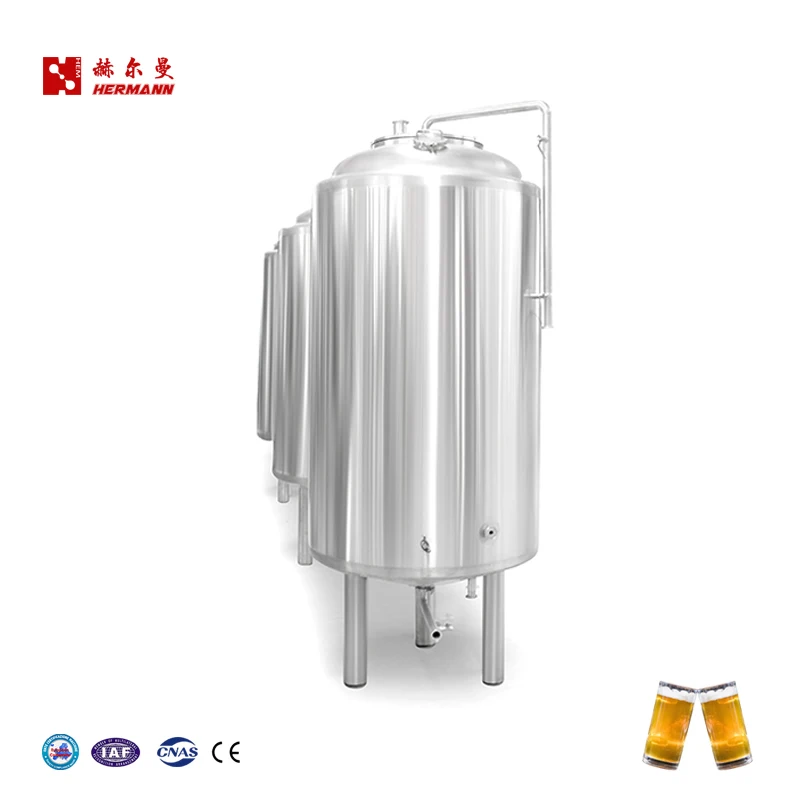
Advanced beer brewing equipment earns its place when it improves measurable production results rather than simply adding automation. A 20-hL brewhouse running three turns can process about 6,000 L of wort per day; improving brewhouse efficiency from 75% to 82% can reduce malt demand for the same extract target. Modern systems also control mash temperature within roughly ±0.5–1°C, manage fermentation cooling automatically, record flow and pressure, and reduce manual valve work. Water use, cleaning time, heat recovery, oxygen pickup, labor hours, and beer losses can therefore be measured batch by batch. For commercial breweries, repeatability and resource use matter more than equipment complexity alone.
That starts in the brewhouse, where milling, mash mixing, heating surface, vessel geometry, pump sizing, wort collection, and control accuracy all affect how much extract reaches the kettle. A brewery processing 800 kg of malt per batch at 75% brewhouse efficiency recovers materially less extract than the same recipe at 82%. Across 250 annual batches, a change of only several percentage points can represent many tonnes of malt that no longer need to be purchased, stored, milled, moved, and removed as spent grain.
The Brewers Association noted in 2026 that breweries operating below 80% mash and lauter extract efficiency can have substantial room for improvement, and described a 10% efficiency improvement as potentially saving roughly one bag of malt per batch in an example brewery. Better extraction, however, depends on control rather than aggressive sparging: excessive runoff can increase polyphenol extraction and dilute wort, so the equipment has to balance yield with beer specifications.
That balance makes instrumentation more useful than nominal tank volume. RTD temperature sensors, pressure transmitters, electromagnetic flowmeters, load cells, variable-frequency pump controls, automated steam valves, and valve-position feedback give operators actual process values instead of estimates. A mash scheduled for 65°C should not repeatedly move between 62°C and 68°C because heat is applied manually; a properly tuned control loop can hold a much narrower band and repeat the same ramp rate during the next 100 batches.
Repeatability has a financial effect because a 2% process difference repeated 300 times is no longer a small brewing variation.
Fermentation benefits from the same level of measurement. A 40-hL cylindroconical tank contains about 4,000 L before headspace allowance, so one poorly controlled batch can occupy valuable tank capacity for days. Glycol-jacket zoning, automated temperature profiles, pressure sensors, sample valves, and programmable cooling reduce the amount of routine adjustment required from an operator. Holding ale fermentation near its recipe target and moving into conditioning according to measured process progress is more reliable than changing cooling manually once or twice per shift.
Tank control then connects to oxygen management during transfer and packaging. Finished beer is especially sensitive to oxygen because oxidation continues after filling. Breweries working on low-oxygen packaging commonly measure dissolved oxygen in parts per billion rather than parts per million; brewing-industry instrumentation has long used calibration points around 150–300 ppb for low-DO beverages. Closed transfers, purged piping, properly sized hoses, CO₂ pressure control, and low-oxygen filling therefore matter more as distribution time grows from several days to several months.
| Operating area | Basic equipment approach | More advanced configuration | Measurable item |
|---|---|---|---|
| Mash | Manual heat adjustment | Automated steam or hot-water control | °C, heating rate, rest time |
| Wort transfer | Fixed-speed pump | VFD pump with flow measurement | L/min, transfer time |
| Fermentation | Manual glycol valve | Programmed cooling profile | °C, pressure, hours |
| CIP | Timed manual rinse | Automated return monitoring | Minutes, temperature, conductivity |
| Packaging transfer | Open or loosely controlled | Closed, purged transfer | DO in ppb, beer loss % |
Once beer quality is stable, utility consumption becomes easier to examine because breweries use far more water than the water ending up in the package. Water enters mash production, vessel rinsing, keg or packaging cleaning, CIP, floors, heat exchange, hose cleaning, and other operations. An EPA water-reuse publication reported an industry range of roughly 4–12 gallons of water per gallon of beer, while older Brewers Association guidance placed average brewery use near 7:1 and documented efficient operations below 3:1.
A 10,000-L production day at a 7:1 water ratio therefore corresponds to about 70,000 L of total water use. Reducing the ratio to 5:1 removes roughly 20,000 L from daily demand before wastewater charges are considered. At 200 comparable production days, the arithmetic reaches about 4 million L per year. Equipment affects that number through spray-ball coverage, rinse sequencing, automatic shutoff, hose practices, tank drainability, conductivity measurement, and reuse of suitable process water.
Cleaning design deserves equal attention because faster CIP is useful only when soil is actually removed. A sanitary tank should minimize dead legs, allow full drainage, use appropriate internal surface finishes, and place spray devices where cleaning solution can contact the complete surface. Automated CIP can control circulation time, return temperature, pump flow, and chemical concentration instead of asking an operator to judge each stage by sight.
-
A 30-minute reduction across two cleaning cycles per production day saves about 250 labor or equipment-hours over 250 days.
-
Cutting a 1,000-L rinse step by 20% saves 200 L per cycle and 50,000 L across 250 cycles.
-
Recovering part of a caustic solution for controlled reuse reduces chemical demand as well as wastewater loading.
-
Logging every 2026 CIP cycle makes missed temperatures or shortened circulation periods easier to identify during quality review.
Cleaning efficiency leads directly to energy use because much of that water must also be heated or cooled. Wort may leave the kettle close to boiling temperature and reach fermentation temperature through a plate heat exchanger. Instead of rejecting all of that heat, a properly designed exchanger can transfer a large share into brewing water and send the heated water to a hot-liquor tank for the next mash, sparge, or cleaning cycle.
For a brewery, the useful question is not whether a system has “energy recovery” on its specification sheet, but how many liters of hot water it returns at a usable temperature after each batch. Heating 2,000 L from 15°C to 75°C requires roughly 502 MJ of thermal energy before system losses are counted. Recovering part of that requirement batch after batch can reduce boiler demand, and vessel insulation lowers losses while wort is held hot.
That same measurement approach should be applied when selecting micro brewery equipment. A 10-hL or 20-hL system should be evaluated by realistic turns per day, heating rate, lauter time, transfer time, available cellar capacity, cleaning time, and packaging throughput rather than by brewhouse size alone. A 20-hL brewhouse rated for three turns may nominally produce 60 hL per day, but it cannot maintain that rate if the cellar has only 200 hL of usable fermentation capacity and a typical beer occupies a tank for 14–21 days.
Capacity planning therefore moves from individual vessels to the whole production line. Ten 40-hL fermenters provide 400 hL of gross tank volume, yet working volume is lower because headspace must be retained. If average residence time is 18 days, adding a faster brewhouse without adding cellar space will mainly create scheduling pressure. Packaging has the same relationship: a filler handling 1,200 cans per hour cannot comfortably absorb 8,000 cans in a short packaging window once setup, rinsing, changeovers, quality checks, and cleaning are included.
Automation can reduce some scheduling pressure by removing repetitive manual work. Valve matrices, recipe control, automatic water dosing, programmable mash rests, pump interlocks, alarms, and production records allow one operator to supervise several steps that previously required repeated physical checks. If three operators spend 45 minutes per batch on valve changes, readings, and manual transfers, 300 batches represent 675 labor-hours; reducing that routine work by 40% returns about 270 hours for cellar work, maintenance, quality checks, or packaging.
Automation is most useful when it removes repeatable manual tasks while leaving recipe judgment, maintenance, sensory evaluation, and quality review with trained brewery staff.
Automation also produces records that can be compared over time. A brewery can review mash temperature, strike-water volume, first-wort gravity, kettle volume, knockout volume, fermentation temperature, tank pressure, cleaning duration, and packaging loss for batch 241 against batches 201–240. A recurring 3% volume loss at one transfer point is much easier to correct when the loss is measured rather than absorbed into a monthly inventory difference.
Equipment economics finally depend on how often those improvements repeat. Assume a brewery makes 300 batches per year and gains only 30 L of additional saleable beer per batch through better transfers and tank recovery. Annual recovered volume reaches 9,000 L. At 330 mL per package, that is roughly 27,000 additional fills before normal packaging rejects and downtime are deducted. A larger 2% yield improvement on a 2,000-L batch equals 40 L per batch, or 12,000 L across the same 300-batch schedule.
Purchase price should therefore be compared with total operating cost over several years. A cheaper brewhouse that requires more manual labor, uses 15% more water, heats slowly, has poor access for sanitation, or cannot accept additional fermenters may cost more during five years of production than a better-specified system. Pumps, seals, valves, sensors, heating surfaces, PLC hardware, spare-parts availability, electrical standards, local service access, and expansion capacity belong in the same calculation as stainless-steel volume.
The most useful specification sheet consequently contains measurable acceptance criteria: vessel working volume, heating rate, cooling rate, pump flow, electrical load, steam demand, glycol demand, CIP flow requirement, maximum operating pressure, control accuracy, material grade, weld treatment, and supported automation functions. When those numbers match the brewery’s recipe mix, 2026 production plan, staffing level, building utilities, and expected batch count, advanced equipment can reduce cost per hectoliter while producing beer with fewer process differences from one batch to the next.